
Choosing Between Plain Questions, Stimuli Testing, Pairwise Comparison, Sequence Flow, First-Click Test, and Shelf Test
An Advanced Survey can combine six different section types, and each one is built for a genuinely different kind of research question. Picking the wrong one doesn't just make the section slightly awkward to build. It usually means the results answer a different question than the one you actually needed answered.
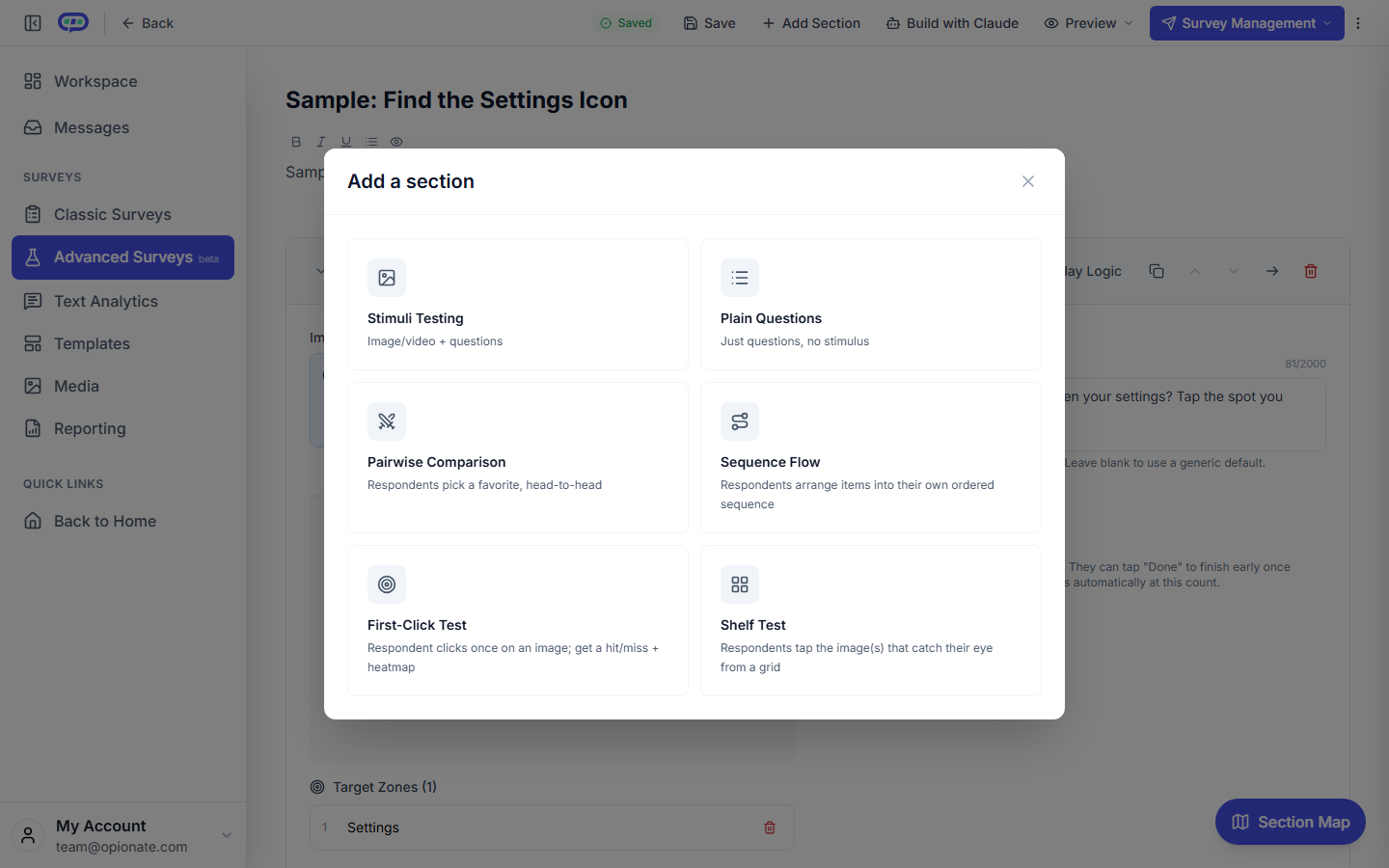
The section picker in the builder. Each card has a one-line description of when to use it.
Plain Questions
The default section type: standard survey questions with no media or comparison structure attached. Use it whenever the research question is a straightforward one: opinions, facts, demographics, satisfaction, anything that doesn't require showing respondents something or forcing a comparison between options.
Stimuli Testing
Use this when respondents need to react to a specific image or video (ad creative, a product concept, packaging, a prototype screen) and the question is "what do you think of this," not "which of these do you prefer." See Setting Up Image and Video Stimulus Testing.
Pairwise Comparison
Use this when the question is genuinely comparative and you want a forced choice rather than independent ratings: "which of these concepts wins," tested head-to-head across a pool of images or videos. This is the right tool when independent ratings would likely cluster near the top and hide real preference. See Pairwise Comparison Testing: Setting Up a Head-to-Head Tournament.
Sequence Flow
Use this when the question is about order, not just selection: which steps come first, how items should be prioritized relative to each other, or what sequence makes sense for a process or navigation structure. Unlike Pairwise Comparison, which asks "which one wins," Sequence Flow asks "where does each one belong relative to all the others." See Introduction to Sequence Flow and Ranking Questions vs. Sequence Flow for more, including when a simpler Ranking question is enough on its own without a full Sequence Flow section.
First-Click Test
Use this when the question is whether respondents can find something on an image without being told where it is: a settings icon, a call to action, a navigation item. Unlike Stimuli Testing's highlight areas (which reveal a region to respondents automatically), First-Click Test zones are never shown. A respondent clicks unprompted, and the click itself is the data. See Introduction to First-Click Test, and First-Click Test vs. Highlight Areas if you're weighing it against a plain Stimulus Section instead.
Shelf Test
Use this when the question is which of several images catches the eye when they're all in front of respondents at once. A respondent sees a pool of up to eight images in a random order, and taps the ones that stand out. Use it for attention in a competitive set, such as finalist packaging, ad visuals, or product photos. It isn't designed to measure preference, and it doesn't explain the reason behind a pick. See Introduction to Shelf Test.
A Quick Decision Guide
- Asking about one thing on its own? Plain Questions (text-based) or Stimuli Testing (needs media).
- Asking respondents to pick a winner between options, one head-to-head at a time? Pairwise Comparison.
- Asking respondents to put things in order? Sequence Flow (or a simpler Ranking question, see Ranking Questions vs. Sequence Flow).
- Asking whether respondents can find something unprompted? First-Click Test.
- Asking which of several images catches the eye when they're all shown together? Shelf Test.
- Just need standard demographic or opinion questions? Plain Questions.
Mixing Section Types
A single Advanced Survey isn't limited to one section type. It's common to open with Plain Questions for screening and demographics, move into a Stimuli Testing, Pairwise Comparison, First-Click Test, or Shelf Test section for the core research task, and close with a few more Plain Questions for follow-up context. Each section behaves independently, so mixing types doesn't require any special handling.
FAQ
Can I convert a section from one type to another after building it?
Section type is generally set when you create the section. If you need a different type, it's usually more reliable to add a new section of the right type than to try to convert an existing one.
Do all six section types support Display Logic?
Display Logic works based on previous answers regardless of the section type asking the current question. Check your specific section for exactly which condition options are available.
Which section types work with Text Analytics?
Any open-ended question, in any section type, can be run through Text Analytics. It's the open-ended question itself that matters, not which section it lives in.
Is Reporting different depending on which section types I use?
Reporting adapts automatically. Pairwise Comparison, Sequence Flow, and First-Click Test sections each unlock their own specific widget types (see Choosing the Right Widget for Your Report). A Shelf Test section shows its images as a gallery above a standard picks chart, and Plain Questions and Stimuli Testing questions use the standard chart types available to any question.
How is Shelf Test different from Pairwise Comparison?
Pairwise Comparison asks respondents to choose between options two at a time, across several rounds. Shelf Test shows the whole pool at once and records which images catch the eye. Choose Pairwise when you need a ranked winner, and Shelf Test when you need to see which options stand out in a set.
How is First-Click Test different from just drawing a highlight area on a Stimulus Section?
They work in opposite directions. A highlight area is shown to respondents automatically, while First-Click Test zones never are. See First-Click Test vs. Highlight Areas for the full comparison.
Ready to build? Head to your survey and try adding each section type from the section picker to see how it fits your specific research question.