
Imagine spending weeks meticulously crafting the perfect questionnaire, only to see it met with an echoing digital silence. In today’s hyper-connected yet over-saturated landscape, sending out hundreds of survey invitations often feels like shouting into a void, resulting in nothing more than a handful of half-hearted responses. As digital fatigue reaches an all-time high, standard methods of capturing the "voice of the customer" are no longer hitting the mark. If you are seeking authentic, actionable insights that truly move the needle for your business, it is time to realize that you don't need a longer form, you need a real conversation.
In the current competitive landscape of digital data collection, a silent crisis is compromising the integrity of market research: the pervasive issue of survey fatigue. We have all encountered the "ghosted" survey, that specific moment of friction where a potential respondent clicks a link only to be confronted by a static, multi-page interface that feels more like a tedious tax document than a meaningful interaction. This predictable cycle of abandonment does more than just lower your response rates; it creates skewed data and hollow analytics, ultimately leaving decision-makers to rely on guesswork rather than grounded truth.
This guide introduces a necessary paradigm shift: the transition to Conversational Surveys. By evolving from rigid, static forms to interactive, chat-based dialogues, organizations can finally move from the mechanical act of "collecting data" to the strategic art of "gaining insights." This is not merely a cosmetic change or a passing design trend; it is a fundamental reimagining of the relationship between the researcher and the respondent. Throughout this blueprint, we explore the evolution of the feedback loop and demonstrate how tools like Opionate are transforming the way businesses listen to their audience, ensuring every voice is heard and every data point is meaningful.
The Traditional Static Form
- A multi-page interface that reads like a tax document
- One stray click and the whole form resets
- Total silence until the final submit - if it ever comes
A Conversational Survey
- One question at a time, in a natural back-and-forth
- Feels like a text message, not a form
- Real engagement instead of silent abandonment
1. The Erosion of the Traditional Survey: Why the Old Method is Breaking
For decades, the standard survey has relied on a singular, unchanging blueprint: the linear web form. We all know what it looks like - a long, intimidating scroll of radio buttons, multi-select checkboxes, and sterile text boxes, often punctuated by a progress bar that seems to move at a snail's pace. While this architecture was efficient for database processing in the early days of the internet, it has become a significant psychological barrier for the modern consumer.
The traditional survey method is fundamentally breaking because it treats the respondent as a data source rather than a human being. These forms are often "impersonal by design", requiring a high cognitive load to navigate and complete. In an era where mobile accessibility is non-negotiable, many legacy forms still struggle with responsiveness, forcing users to pinch and zoom through tiny grids.
This friction leads to "survey abandonment," where users simply give up, or "straight-lining", where they click through answers randomly just to reach the end. When the process feels like a digital interrogation, the quality of the resulting data inevitably suffers. As these static methods continue to fail in the face of dwindling attention spans, a more sophisticated alternative has emerged: the Conversational Survey. This modern solution effectively bridges the gap between administrative simplicity and professional analytical power, replacing the outdated form with an engaging dialogue that respects the user's time.
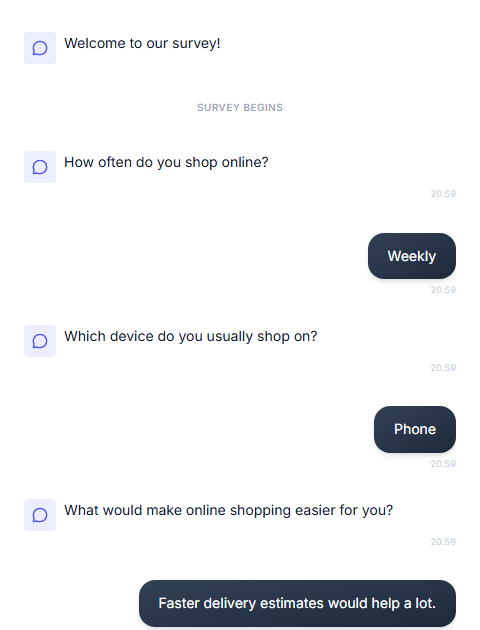
Opionate's chat-based take experience - one question at a time, in a natural, texting-style flow.
2. Defining the Conversational Survey: A New Era of Dialogue
At its core, a Conversational Survey is a feedback methodology that replaces the "questionnaire" with a "conversation". Unlike traditional forms that present a block of questions all at once, a conversational survey delivers information one-to-one through an interface that looks and feels like a messaging app. It is designed to mimic the natural, back-and-forth flow of a human dialogue.
The basic concept is rooted in interaction design. Instead of navigating a sterile grid of checkboxes, the respondent engages with a chat-like UI where questions appear as message bubbles. This approach leverages the same psychological framework we use every day in apps like WhatsApp, Messenger, or Telegram. By transforming the data collection process into a dynamic exchange, the conversational survey moves away from the cold, mechanical nature of "data entry" and toward a human-centric experience where the software speaks with the user, not at them.
3. The Science of Connection: Decoding the Psychology and Anatomy of Engagement
To understand why conversational surveys are rapidly replacing outdated methods, we must look beyond aesthetics. The shift is rooted in a fundamental change in human digital behavior. By aligning data collection with how our brains process information, this format bridges the gap between a business’s need for data and a user’s need for a frictionless experience.
The Psychology: From "Homework" to "Interaction"
Traditional surveys often fail because they inadvertently trigger a "task-based" response in the brain. When a respondent opens a link and sees a massive block of questions, their brain immediately calculates the effort required to finish. In an era of digital fatigue, the brain often decides the chore isn't worth the time, leading to instant abandonment.
Conversational surveys solve this by utilizing a technique called "Chunking". By presenting only one question at a time, you remove the visual weight of the task. Psychologically, this transforms the experience from a digital interrogation into a natural interaction. We are pre-conditioned to respond to chat bubbles; it feels familiar and significantly more human. This creates a sense of momentum - once a user answers the first "bubble," the back-and-forth rhythm makes it psychologically easier to continue until the end.
The Anatomy: The DNA of a High-Velocity Dialogue
A high-performing conversational survey is an orchestrated interface designed to simulate presence and flow. Its anatomy consists of three critical pillars:
- Micro-Interactions: Subtle cues like "typing indicators" (the three moving dots) create a sense of anticipation and the feeling that someone is listening on the other side. This reduces the sense of isolation, making the user feel they are in a two-way relationship.
- Mobile-Native Design: We live in a mobile-first world. The anatomy of a conversational survey is built specifically for the 6-inch screen, eliminating the need for "pinching and zooming".
- Adaptive Logic (The "Digital Brain"): Unlike a rigid script, a conversational interface includes dynamic branching. If a customer expresses frustration, the survey doesn't move to the next generic question; it pivots instantly to offer empathy or ask for specific details.
The Creator’s Edge: Translating Engagement into Results
For the marketer or researcher, the move to conversational architecture delivers tangible results:
- Authentic "Data Truth": In a friendly, low-pressure chat environment, people tend to drop their "survey-taking" guard, providing more honest, natural-language feedback.
- Deeper Insights: Because the interaction feels like a dialogue, respondents are more likely to provide detailed, open-ended answers. They aren't just checking boxes; they are telling their story.
- Humanizing the Brand: By using natural language, emojis, and a casual tone, you transform a cold data-collection chore into a positive customer service experience.
4. Opionate: Turning Data Points into Natural Conversations
Opionate is not just another survey tool; it is a platform built with a "conversation-first" philosophy. Unlike legacy tools that attempt to retroactively fit a chat interface onto old-fashioned forms, the core experience of Opionate is natively chat-based. This ensures every question you design is automatically transformed into a fluid, mobile-responsive dialogue, optimizing user engagement from the very first interaction.
Designed to be accessible for everyone, Opionate provides a seamless path from raw data needs to deep human insights. The platform’s most powerful features are available to explore freely, allowing you to build high-converting surveys without the friction of complex setups or immediate costs.
A Quick Start Guide to Your First Chat-Based Survey
Creating a modern, engaging survey with Opionate takes only a few moments:
- Enter the Workspace: Visit the Opionate Dashboard and click the "Create Survey" button.
- Choose Your Creation Path:
- Generate with AI (Prompt-to-Survey): Describe your goals and let our AI build the survey for you. Every new account receives 200 free credits to get started.
- Add Manually: Take full control and design your survey from scratch - this option is completely free and allows for unlimited customization.
- Customize and Launch: Tailor your branding, refine your logic flows, and hit Publish. Your conversational survey is now live.
Don't let valuable feedback vanish into static forms. Experience the future of feedback and create your first survey with Opionate today - because the best insights come from the best conversations.