
AI categorization of open-ended survey responses is right often enough that it's tempting to stop checking it at all - which is exactly the point at which it becomes worth checking again. Most responses are clear-cut: a direct complaint about pricing gets sorted into a pricing category without much room for ambiguity, and it'll keep landing there reliably response after response. The trouble isn't the clear-cut majority. It's the smaller, predictable slice of responses that are genuinely ambiguous even to a careful human reader, where "the AI got it wrong" and "there wasn't really a clean right answer" are hard to tell apart from the outside - and knowing which is which is what turns blind trust into calibrated trust.
Table of Contents
- What a Confidence Score Actually Tells You
- The Response Types Most Likely to Get Miscategorized
- A Practical Spot-Check Habit
- When the Stakes Justify a Full Review
- A Worked Example
- FAQ
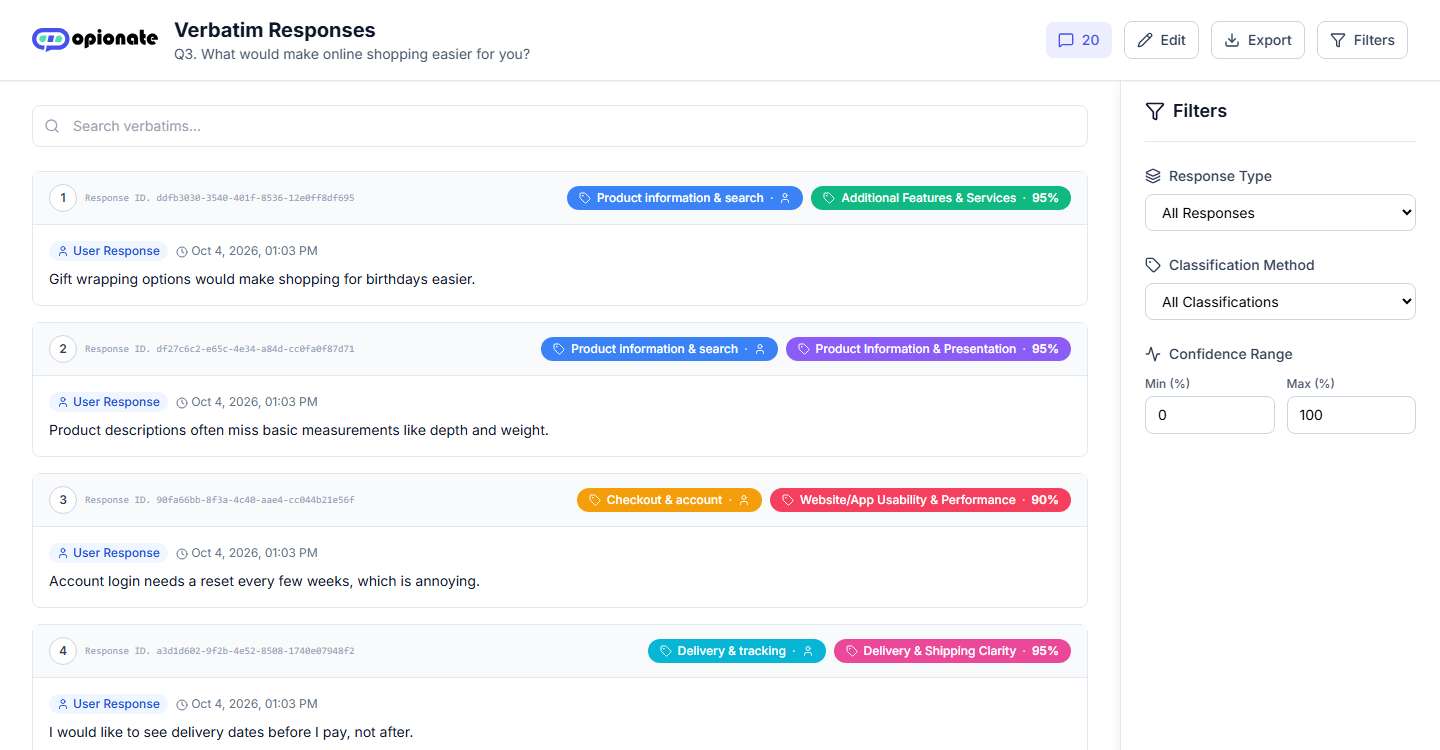
A confidence score next to each classification - a real signal for where to spot-check first.
What a Confidence Score Actually Tells You
Each AI-assigned category comes with a confidence score - a number reflecting how certain the system was about that specific assignment, not a guarantee of correctness. A high score means the response's language matched the category's definition clearly and unambiguously, the kind of response that would land in the same bucket no matter who or what was reading it. A lower score means the response sat closer to a boundary - it plausibly belonged in more than one category, used vaguer or more indirect language, or only partially matched the category definition it ended up assigned to.
The practical use of the score isn't to trust every high-confidence assignment blindly and distrust every low one - it's to prioritize where a human reviewer's limited time goes. Reading through a thousand classified responses to check every single one defeats the purpose of automating the sort in the first place; reading through the lowest-confidence handful concentrates your attention exactly where the system itself is telling you it was least sure, which is a far more efficient use of a reviewer's time than reading randomly or not reviewing at all.
Mixed Topics
A response touching two themes at once is the hardest case to classify cleanly.
Very Short Responses
Too little text for the model to confidently anchor a category to.
Sarcasm & Irony
Literal sentiment analysis misses tone that flips the actual meaning.
The Response Types Most Likely to Get Miscategorized
A handful of response patterns account for a disproportionate share of the errors that do happen, and knowing them in advance makes spot-checking faster and more targeted. Mixed-sentiment responses - "the product is great but support has been slow" - genuinely touch more than one theme at once, and if your classification only allows a single category per response, whichever half gets picked can feel arbitrary even though it's a defensible call either way. Short, low-information responses - "meh," "it's fine," "no comment" - simply don't contain enough signal to categorize confidently, and a low confidence score on these is the system correctly reporting genuine ambiguity in the input, not a failure on its part. Sarcasm and indirect language - "oh sure, waiting three weeks for a reply was great" - can read as literally positive if the ironic tone isn't picked up, a known weak spot for automated text analysis generally, not specific to any one tool. And responses using company-specific or unusual terminology - internal product nicknames, acronyms, or slang particular to your audience - are more likely to be misread than responses using plain, common language, simply because the intended meaning depends on context a general-purpose reading of the text wouldn't have.
Recognizing these patterns is useful beyond just spot-checking - if your data is unusually full of one of them (a lot of sarcasm in a disengaged workforce, a lot of internal jargon in a technical product's feedback), it's worth weighting your review time even more toward that specific risk.
A Practical Spot-Check Habit
A lightweight, repeatable spot-check routine catches most of what's worth catching without turning review into a second full read-through. Start with the lowest-confidence responses in each category - even a review of the bottom 5-10% by confidence score surfaces a disproportionate share of genuine misclassifications, since that's exactly the segment the system is already flagging as uncertain. Next, skim a small random sample from each category regardless of confidence - purely low-confidence review can miss a rarer failure mode: a response the system was confidently wrong about, which happens less often but isn't impossible, particularly for a category whose definition was itself a little fuzzy to begin with. Finally, look specifically at any category with a surprisingly small or surprisingly large response count relative to what you expected going in - a category that's oddly empty or oddly overflowing is often a sign that its definition overlapped with a neighboring category more than intended, catching a systematic pattern rather than a one-off individual error.
When the Stakes Justify a Full Review
Spot-checking is the right level of scrutiny for most reporting use cases - an internal dashboard, a quarterly trend readout, a first pass at understanding what a batch of feedback is about. It's not the right level for every use case. A classification result feeding a decision with real consequences attached - identifying accounts at risk of churn for a save campaign, flagging responses that indicate a safety or compliance concern, categorizing something that will be quoted directly in a report going to a regulator or board - deserves a full human review of every response, not just the uncertain ones, because the cost of a single missed misclassification is high enough to outweigh the time saved by sampling. The confidence-score spot-check is a calibrated-trust tool for ordinary reporting, not a substitute for full review wherever the downside of an individual error is genuinely serious.
A Worked Example
A customer success team classifies 600 open-ended churn survey responses into reasons for leaving, and a first look at the results shows "pricing" as the largest category by a wide margin. Before presenting that finding, the team reviews the lowest-confidence 8% of responses across all categories - about 48 responses - and finds a real pattern: a cluster of mixed-sentiment responses mentioning both price and a specific missing feature were split roughly evenly between "pricing" and "missing feature," landing in whichever category happened to be listed first in the response, with confidence scores meaningfully lower than the rest of the dataset. Reading those responses directly, the team judges that most of them are really about the missing feature not being worth the price - closer to a value complaint than a pure price complaint. They relabel that cluster into a new "value/feature-price mismatch" category and rerun, and the revised breakdown shows pricing as a real but smaller theme than the first pass suggested, with the new category surfacing a more specific, more actionable finding underneath what looked like a simple pricing complaint at first glance.
FAQ
What confidence score should I treat as "low enough to check"?
There's no universal cutoff, but reviewing roughly the bottom 5-10% by confidence score within your dataset is a reasonable, time-efficient starting habit - adjust up if your data is unusually ambiguous (a lot of mixed sentiment, jargon, or short responses) and down if it's mostly short. Clear, direct language.
Does a low confidence score always mean the classification is wrong?
No - it means the response was genuinely harder to categorize confidently, which is sometimes because the AI struggled and sometimes because the response itself was ambiguous even to a human reader. Reading the response directly is the only way to tell which is true in a specific case.
Should I re-classify everything if I find a pattern of errors in my spot-check?
If the pattern traces back to a category definition that was too broad or overlapping with another, refining the definition and rerunning is usually worth it - a systematic pattern affecting many responses is a different, more consequential problem than a handful of isolated individual misclassifications.
Is spot-checking enough for an academic or regulatory-facing report?
Generally not - those contexts usually call for a full review, or at minimum a documented, statistically justified sample size and inter-rater reliability check, rather than a lightweight confidence-based spot-check built for everyday business reporting.
For the full workflow around building and refining classifications, see Introduction to Text Analytics and Catching AI Miscategorization Before It Skews Your Report.