
Knowing that 34% of survey responses fall into a "pricing" category is a finding, but it's a shallow one - it groups together someone who thinks the product is overpriced across the board, someone who thinks one specific plan tier is a bad deal, and someone comparing your price directly against a named competitor's, as though all three were saying the same thing. They're not. A first-pass classification is built to answer a broad question well; it isn't built to answer the narrower, more specific question that often turns out to matter more once you know which broad category deserves the closest look. That's what a second pass, scoped to just the responses inside one category, is for.
Table of Contents
- What a Second Pass Actually Does
- When It's Worth the Extra Step
- Scoping a Second Pass Well
- How Deep Is Too Deep
- A Worked Example
- FAQ
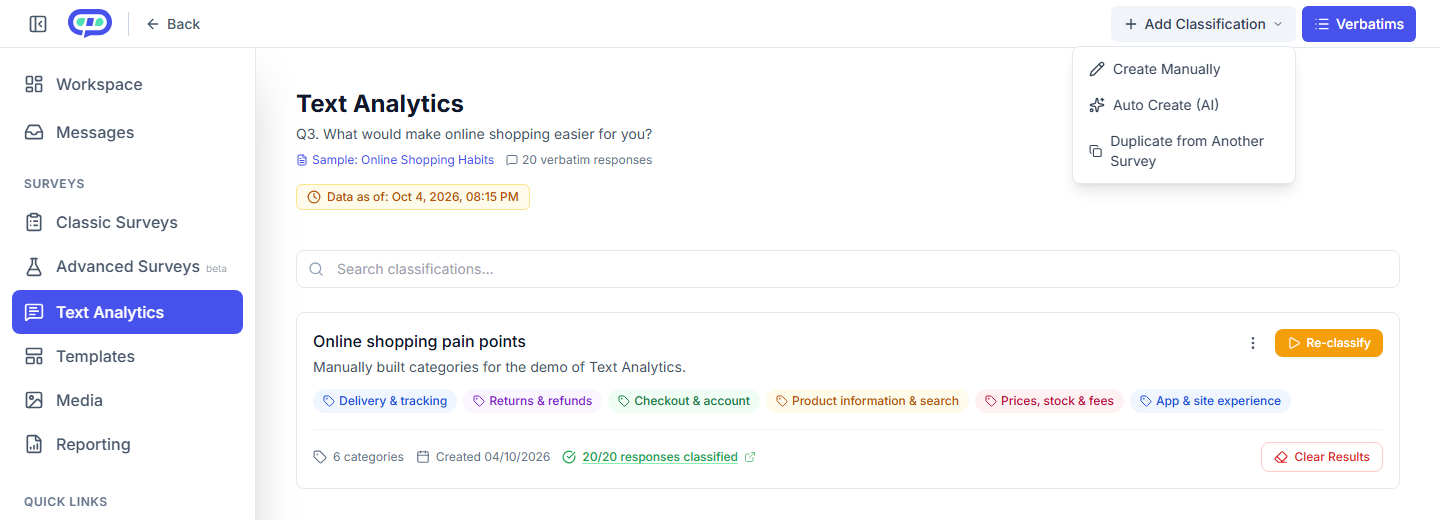
Adding a second classification pass on top of the first, scoped to drill deeper.
What a Second Pass Actually Does
A second-pass classification takes the responses already sorted into one category from an earlier pass and runs a fresh classification on just that subset, with its own goal and its own set of sub-categories, without touching or re-sorting anything outside that original category. The result is a category that used to be a single number - "34% pricing" - broken into its own internal structure: maybe 40% of those pricing responses are about overall price level, 35% are about a specific plan's value, and 25% are direct competitor comparisons. Nothing about the original, broader classification changes; the second pass is purely additive, adding a layer of detail underneath one category rather than replacing or redoing the first pass.
When It's Worth the Extra Step
A second pass earns its place specifically when a category is both large and actionable in a way that a single number can't fully support - if "pricing" is your biggest category and pricing decisions are actually on the table, knowing the internal breakdown genuinely changes what gets proposed. It's less useful for a small category that isn't going anywhere strategically regardless of its internal structure, or for a category where the first pass already answered the specific question you needed answered. A good rule of thumb: if you find yourself wanting to read through a category's responses by hand to understand what's really going on inside it, that's usually a sign a structured second pass would save time and produce a more consistent, reportable answer than an informal read-through would.
It's also the right move whenever a category turns out to be a genuine grab-bag - a "shipping" category that on closer reading contains complaints about speed, damage, and communication as three genuinely distinct problems calling for three different fixes is exactly the kind of situation a second pass is built to untangle, rather than trying to redefine the original category boundaries and rerun the whole first-pass classification from scratch.
An Unscoped Second Pass
- Re-classifies everything again from scratch
- No clearer than the first pass - just slower
- Doubles the review work for no new insight
A Scoped Second Pass
- Drills into one specific category only
- Splits a broad theme into genuinely distinct sub-themes
- Adds real depth exactly where it is needed
Scoping a Second Pass Well
The same discipline that makes a first-pass classification goal work well - a clear angle, a sense of granularity, anything already known worth anchoring against, covered in more depth in our guide on writing a good classification goal - applies just as directly to a second pass, with one addition: it's worth being explicit about what you're hoping the sub-categories will reveal that the parent category didn't. If the goal for drilling into "pricing" is simply "find sub-themes in the pricing responses," you're likely to get a similarly generic split as an underspecified first-pass goal would produce. A goal like "split by whether the complaint is about overall price level, a specific plan's value, or a named competitor comparison" gives the second pass the same kind of clear, actionable target a first pass benefits from.
How Deep Is Too Deep
A second pass is usually as deep as it's worth going, and a third pass - drilling into a sub-category of a sub-category - is worth a moment's pause before running. Each additional layer shrinks the underlying response count further, and a sub-sub-category built on forty or fifty responses starts running into the same small-sample caution that applies to any segment-level finding - see our guide on why segment-level results are noisier than the topline for the underlying reasoning. If a category is large enough that a third layer of drilling would still leave each resulting group with a reasonably sized sample, it can be worth it; if it would leave you reading percentages built on a couple dozen responses each, the honest move is treating that layer as a qualitative read of individual responses rather than a percentage breakdown that implies more precision than the sample size actually supports.
A Worked Example
A subscription meal-kit company's first-pass classification of 800 cancellation-survey responses shows "too expensive" as the largest category at 29%, roughly 230 responses. Rather than reporting that number alone, the team runs a second pass scoped to just those 230 responses, with a goal of splitting by the specific nature of the price complaint: is it about the price relative to grocery store alternatives, the price relative to a specific promotional rate that expired, or the price relative to portion size or quality received. The results split roughly 45% grocery-alternative comparisons, 33% expired-promotion complaints, and 22% portion-or-quality-relative-to-price complaints - three meaningfully different findings hiding inside the original single "too expensive" number, each pointing toward a different lever: competitive positioning messaging, promotional pricing strategy, and portion sizing, respectively. The team prioritizes the expired-promotion segment first, since it's the most directly and cheaply addressable of the three, a decision the original single-category finding wouldn't have been specific enough to support on its own.
FAQ
Does a second pass cost more or take longer than a first pass?
It's scoped to a smaller subset of responses, so it's typically faster to run than the original first pass, though the setup work - writing a good goal and reviewing the resulting sub-categories - takes real time regardless of the subset's size.
Can I run a second pass on more than one category from the same first-pass classification?
Yes - there's no restriction to just one; it's common to drill into your two or three largest or most strategically relevant categories separately, each with its own tailored second-pass goal.
Should sub-category percentages be reported as a share of the whole dataset or just the parent category?
As a share of the parent category, generally - "45% of pricing complaints were about grocery-store comparisons" is a clearer, more useful claim than converting that back into a share of all 800 original responses, which would understate how concentrated the finding actually is within the group it's describing.
How do I know if a category is a genuine grab-bag worth splitting versus a properly coherent single theme?
Read fifteen or twenty responses from the category together. If they clearly cluster into two or three distinct sub-stories on a quick read, it's a grab-bag worth a second pass; if they all genuinely feel like variations on one consistent theme, the category is probably fine as it stands.
For the full classification workflow, see Introduction to Text Analytics and Writing a Good Classification Goal.