
One response landing in the wrong category is a rounding error - a single misclassified comment out of a few hundred won't move a percentage enough for anyone to notice, and it isn't worth chasing down individually. The real risk isn't the occasional isolated mistake, it's a systematic pattern - the same specific type of response consistently landing in the wrong bucket, again and again, in a way that quietly shifts a whole category's percentage before anyone's looked closely enough to catch it. A systematic pattern doesn't look like an obvious error from the outside. It looks like a normal, plausible-seeming breakdown, right up until someone reads the actual responses sitting inside a specific category and realizes a meaningful chunk of them don't belong.
Table of Contents
- Individual Errors vs. Systematic Patterns
- Warning Signs Worth Checking
- A QA Workflow That Catches Patterns, Not Just Mistakes
- Fixing a Pattern Once You've Found One
- A Worked Example
- FAQ
An Individual Error
One response, miscategorized in isolation - worth a correction, not a redesign.
A Systematic Pattern
The same type of error, repeated - worth fixing at the category definition itself.
Individual Errors vs. Systematic Patterns
An individual error is a single response that got sorted into the wrong category, for reasons that are essentially random from the dataset's perspective - a borderline response that could plausibly have gone either way, or a genuine edge case with no clean answer. These happen in any classification process, AI-assisted or fully manual, and a handful scattered across a large dataset rarely change a headline finding by enough to matter.
A systematic pattern is different in kind, not just in scale: it's a specific, recurring type of response - a particular phrasing, a specific mixed-sentiment structure, a piece of company jargon - that consistently gets sorted the same wrong way, every time it appears. Because it's consistent rather than random, its effect on your percentages doesn't average out the way scattered individual errors do; it accumulates in one direction, and a category can end up meaningfully over- or under-counted as a direct result. The individual-error problem is solved by the spot-checking habit covered in our guide on when to trust AI categorization. The systematic-pattern problem needs a different kind of check, aimed specifically at finding recurring structure in the errors rather than just sampling for isolated ones.
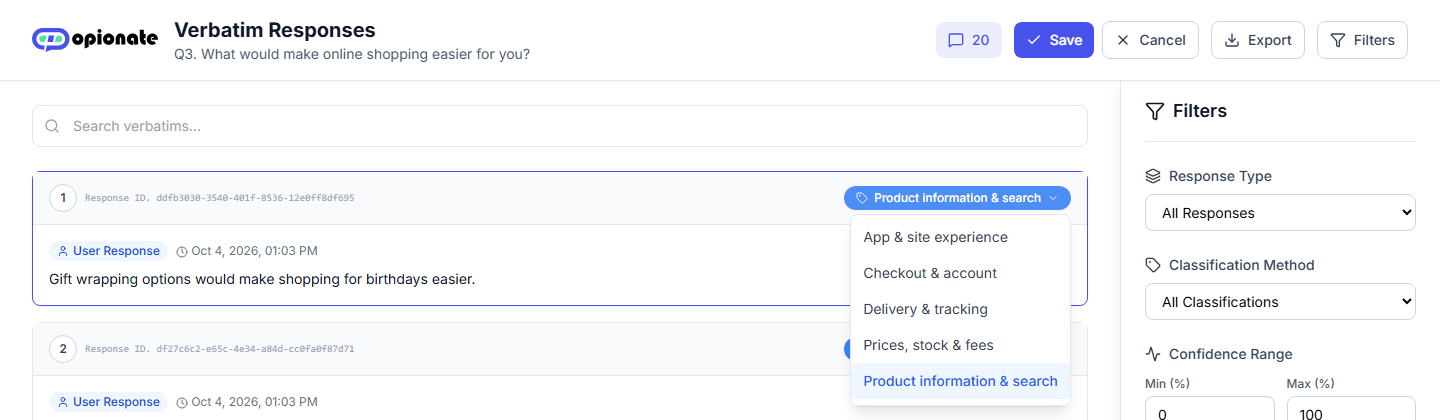
Reviewing and correcting a classification directly - the fastest way to check a warning sign.
Warning Signs Worth Checking
A few patterns in the results themselves are worth treating as prompts to look closer, even before you've found anything wrong. A category that came out meaningfully larger or smaller than you expected going in, based on general knowledge of your audience or prior waves of the same survey, deserves a direct look at a sample of what's actually sitting inside it - sometimes the surprise is a genuine, real finding, and sometimes it's a sign that a neighboring category's definition is pulling in responses that don't really belong. A cluster of unusually low confidence scores concentrated in one specific category, rather than spread evenly across all of them, often points to that category's definition overlapping with another's, or being written more vaguely than the rest. And a category whose size shifted sharply between waves of a tracked survey, with no obvious real-world explanation, is worth checking against whether anything about the classification process itself changed between waves - a reworded classification goal, a redefined category boundary - before treating the shift as a genuine trend.
A QA Workflow That Catches Patterns, Not Just Mistakes
Beyond the confidence-based spot-check covered elsewhere, a pattern-focused QA pass benefits from reading a sample within specific categories rather than a random sample across the whole dataset - pulling fifteen or twenty responses from your largest category, and separately from any category that surprised you, and reading them together as a group rather than one at a time. Reading a group together makes a recurring pattern visible in a way reading responses individually and in isolation doesn't - a single misplaced response looks like a one-off mistake; five similarly-structured misplaced responses read together clearly look like a pattern with a specific, fixable cause.
It's also worth periodically checking a category's edges specifically - the handful of responses in a category with the lowest confidence scores, since that's exactly where a category boundary that's drawn too broadly or too vague tends to show up first, before it's pulled in enough borderline responses to visibly change the category's overall size.
Fixing a Pattern Once You've Found One
Once a systematic pattern is confirmed, the fix is almost always at the category-definition level, not at the level of manually reassigning each individual affected response - correcting fifteen responses by hand addresses those fifteen, but leaves the same underlying ambiguity in place for the next batch of similar responses in a future wave. Tightening the category definition that's causing the overlap - adding an explicit rule for the specific pattern you found, or an example response illustrating exactly where the boundary sits - and rerunning the classification fixes the pattern at its source, the same way refining a classification goal (covered in our guide on writing a good classification goal) fixes a whole category rather than one response at a time. This is also worth documenting somewhere accessible to whoever runs the next wave of the same tracked survey, so the same definition ambiguity doesn't quietly reappear next quarter.
A Worked Example
A B2B software company classifies 350 renewal-survey comments into five categories, and "product quality" comes out unexpectedly large at 44% - well above what the team's account managers, working the same accounts, would have guessed from ongoing conversations with customers. Reading twenty responses from that category together reveals a clear pattern: a recurring phrase structure - "the integration with [specific competitor product] doesn't work well" - is consistently landing in "product quality" instead of a more specific "integrations" category that exists in the classification, apparently because the surrounding sentence structure reads similarly to genuine general product-quality complaints. The team tightens the integrations category's definition with an explicit rule ("any complaint mentioning a specific named integration or third-party connection belongs here, even if phrased as a general product complaint") and reruns the classification. Product quality drops to 31%, integrations rises from 6% to 19%, and the revised breakdown lines up far better with what the account management team was already hearing directly - a more specific, more actionable finding than the original, quietly-inflated product-quality number would have supported.
FAQ
How often should I run this kind of pattern check?
For a one-off analysis, once, before the results go into a report. For a tracked survey run wave after wave, it's worth a check on the first wave using a new category set, and a lighter check on subsequent waves specifically if a category's size shifts unexpectedly.
Is a systematic pattern more likely with certain kinds of data?
Yes - data with a lot of domain-specific jargon, recurring phrase structures (like references to named competitors or integrations), or a lot of mixed-sentiment responses is more prone to this than plainly-worded, single-theme responses. Knowing your data's quirks in advance helps target the check.
Should I read every category's responses, or just the surprising ones?
Prioritizing categories that surprised you, and your largest category regardless of whether it surprised you, covers most of the risk efficiently. Reading a sample from every category is more thorough but rarely necessary unless the analysis is unusually high-stakes.
Does fixing a category definition and rerunning change previously reported results?
It can, which is worth being upfront about if you're revising a finding that's already been shared - a documented, well-justified correction is more credible than a silently revised number appearing in a later report with no explanation.
For the full workflow around building and refining classifications, see When to Trust AI Categorization and Writing a Good Classification Goal.