
"Sentiment analysis" gets talked about as though it's a fundamentally different, more specialized capability than ordinary theme categorization - as if positive, neutral, and negative required some separate engine under the hood. In practice, for most teams' actual needs, it doesn't. Positive, neutral, and negative are categories, no different in kind from "pricing," "onboarding," or "missing feature" - they're just categories that happen to describe tone rather than topic, built the same way, reviewed the same way, and just as capable of being defined well or defined poorly.
Table of Contents
- Sentiment Is a Classification, Not a Separate Tool
- Why Sentiment Is Harder Than It Looks
- Writing Category Definitions That Actually Hold Up
- Sentiment Alone Is Rarely the Full Answer
- A Worked Example
- FAQ
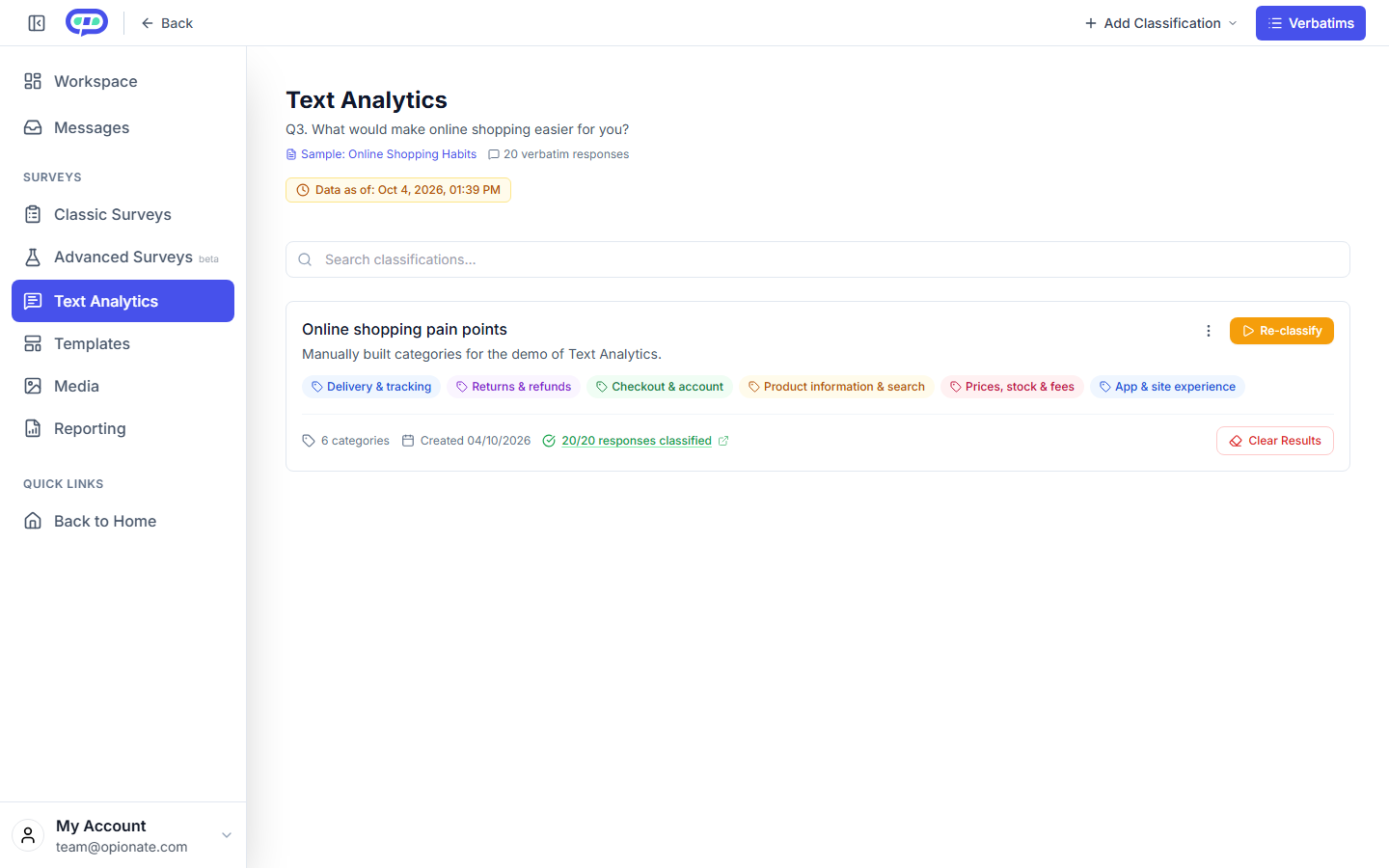
Sentiment runs through the same classification engine as any other category - not a separate tool.
Sentiment Is a Classification, Not a Separate Tool
Treating sentiment as "just another classification" rather than a distinct capability has a genuinely practical upside: it means everything you already know about building a good classification - a clear goal, well-written category definitions, a review pass on uncertain results - applies directly, without needing to learn a separate workflow. Defining three categories (positive, neutral, negative) with clear boundaries and letting the same classification process sort responses into them produces a sentiment breakdown exactly the way defining categories like "pricing" or "onboarding" produces a topic breakdown. The output looks the same - a percentage breakdown, individual responses assignable and reviewable, exportable the same way.
Mixed Sentiment
One response can praise and criticize in the same breath.
Sarcasm
Literal reading of the words misses a tone that flips the actual meaning.
Neutral-Sounding Negativity
A flat, calm complaint reads as neutral unless the category definition catches it.
Why Sentiment Is Harder Than It Looks
Despite being conceptually simple - three buckets, roughly - sentiment is one of the harder classifications to get clean results from in practice, for reasons that have nothing to do with the classification process itself and everything to do with how people actually write. Mixed-sentiment responses are the biggest source of friction: "the product works well but support took forever to respond" contains a genuine positive and a genuine negative in the same sentence, and forcing it into a single bucket means picking a side that a different, equally reasonable reader might pick differently. Neutral is a surprisingly slippery category too - it's supposed to capture genuinely indifferent responses, but it often ends up as a catch-all for anything that isn't clearly, strongly one direction or the other, which quietly changes what "neutral" means in your results from "the respondent felt neutral" to "the response was hard to read as strongly positive or negative," a meaningfully different claim. And tone carries real information a plain reading of the words can miss - "sure, that worked out great" reads as positive at face value and negative in the tone it's actually written in, the same sarcasm risk covered in our guide on when to trust AI categorization.
Writing Category Definitions That Actually Hold Up
A sentiment classification holds up better when the category definitions get specific about how to handle the hard cases up front, rather than leaving "positive," "neutral," and "negative" undefined and hoping the labels are self-explanatory. For mixed-sentiment responses, decide explicitly whether you're allowing multi-label assignment (a response can be both positive and negative at once, if your classification setup supports it - see our guide on multi-label vs. single-label classification for the tradeoffs) or whether a single-label setup should default to the response's dominant or final sentiment, and say so in the category definition itself. For neutral, define it narrowly and deliberately - "genuinely indifferent or purely factual, with no clear positive or negative framing" reads very differently to a classifier than an undefined "neutral" bucket that ends up absorbing every response that isn't emphatically one-sided. Including two or three example responses for each category, especially borderline ones, does more to stabilize the results than a longer, more abstract definition ever will - concrete examples anchor the boundary in a way a general description can't.
Sentiment Alone Is Rarely the Full Answer
A clean positive/neutral/negative breakdown answers a genuinely limited question - roughly how people feel, in aggregate - and it's worth being honest about how little that alone tells you to act on. Knowing that 62% of responses were negative doesn't tell you what to fix; it just tells you that something needs fixing, which is usually already obvious from a declining satisfaction score without needing a sentiment classification to confirm it. The more useful move is running sentiment alongside a topic classification - what's being talked about - and cross-tabulating the two, so the finding becomes something like "negative sentiment is concentrated specifically in responses about the checkout flow" rather than just "a lot of people are unhappy." Sentiment on its own is a summary statistic; sentiment crossed with topic is closer to a finding you can actually act on.
A Worked Example
A retailer runs a sentiment classification on 500 post-purchase survey comments and finds a 58% positive, 24% neutral, 18% negative split - a reasonable-looking overall picture, but not something anyone can act on directly. Cross-tabulating sentiment against a separate topic classification (shipping, product quality, customer service, website experience) reveals that negative sentiment isn't spread evenly - it's concentrated heavily in the shipping category, where 41% of comments are negative, against single-digit negative rates in every other topic. The team also notices, reviewing the flagged mixed-sentiment responses specifically, that a meaningful cluster praises the product itself while criticizing shipping speed in the same breath - comments that a single-label sentiment pass alone would have forced into one bucket or the other, losing half the finding either way. The combined view - sentiment by topic, with mixed responses visible rather than collapsed - points the team toward a shipping-specific fix rather than a vague, company-wide "improve customer happiness" initiative that the raw sentiment split alone would have suggested.
FAQ
Should I allow a response to be both positive and negative at once?
If mixed-sentiment responses are common in your data, yes - a multi-label setup captures that nuance more honestly than forcing a single dominant label. See our guide on multi-label vs. single-label classification for how that choice affects your reported percentages.
How many sentiment categories should I use - just three, or more?
Three (positive, neutral, negative) is the most common and easiest to report on; some teams add a fourth "mixed" category specifically to avoid forcing ambiguous responses into a single-label boundary. More granular scales (strongly positive to strongly negative) add nuance at the cost of smaller, noisier category sizes.
Is sentiment classification less accurate than topic classification?
Not inherently less accurate, but more prone to specific failure modes - sarcasm, mixed sentiment, and an overly broad "neutral" bucket - that topic classification is less exposed to. Clear, example-anchored category definitions address most of this.
Should sentiment always be reported alongside a topic breakdown?
It's not strictly required, but a sentiment-only finding is usually too vague to act on directly. Crossing sentiment with topic, or with a segment like tenure or plan tier, is what usually turns "people are unhappy" into something specific enough to fix.
For the full classification workflow, see Introduction to Text Analytics and Writing a Good Classification Goal.